Harry Styles Is Back — And the World Stopped to Watch
The Together, Together Era Is Already the Biggest Cultural Moment of 2026.
The streets of Amsterdam smelled of rain and anticipation. Tens of thousands of fans from every corner of the world had descended on the Dutch capital for one reason and one reason only: to be there on the night Harry Styles finally, triumphantly, returned to the stage. Three years after his last tour ended. One career-defining new album. One unconfirmed engagement. One extraordinary opening night. And the entire world was watching every single second of it.
Chapter One: The Night Amsterdam Stood Still
It is May 16, 2026. The Johan Cruijff Arena — a 60,000-capacity colossus on the southern edge of Amsterdam — is sold out. Not just sold out, but packed so tightly with emotion that the air itself seems pressurized. Walk the city’s elegant canal streets that Saturday afternoon and you would have thought Amsterdam had been temporarily annexed by the English-speaking world. British accents mingled with American twangs. Banners in a dozen languages bobbed above café terraces. Stores reported record tourist spend. Hotels had been booked out for weeks.
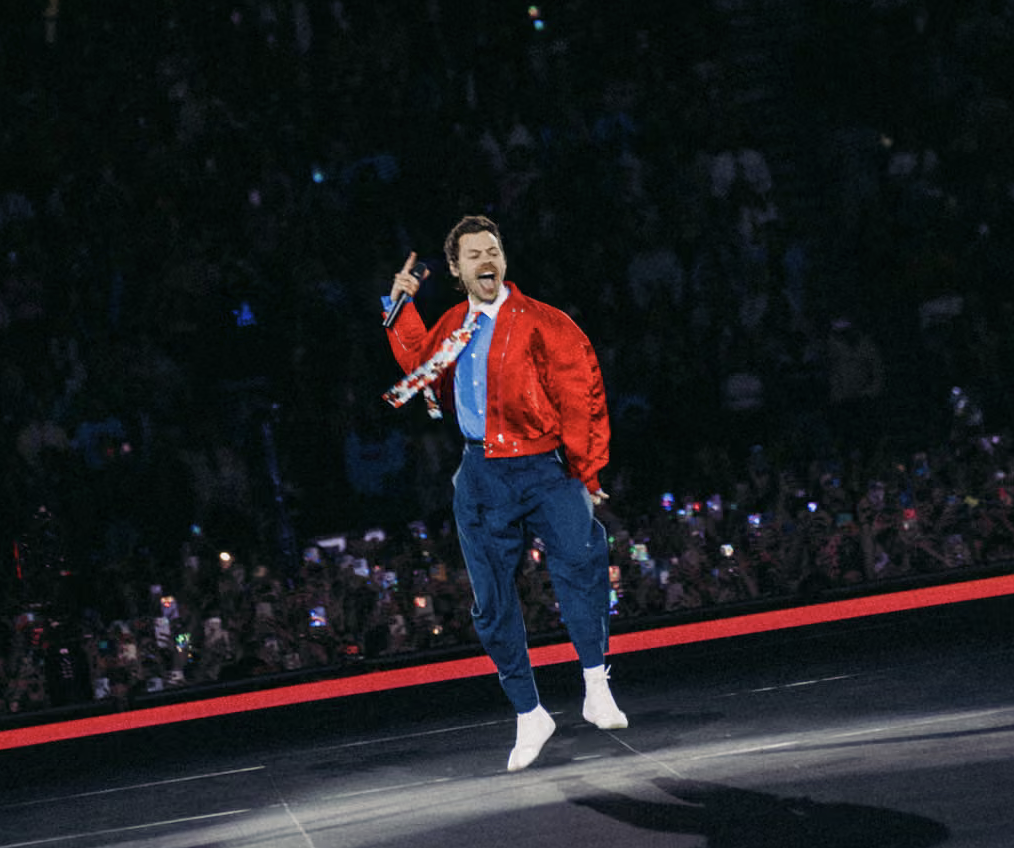
Then the lights went down, and Harry Styles walked onto the stage — and the roar that erupted was something beyond mere sound. It was release. Gratitude. Joy. It was the collective exhale of millions of fans who had waited, and waited, and waited, and were finally, finally being answered.
The show opened with “Are You Listening Yet” — the very first track off his new album — and from the opening chord it was abundantly clear: this is not the same Harry Styles who left the stage in 2023. He is sharper. More focused. More in command of a room — and the room he was commanding held sixty thousand people.
Throughout the evening, the performance oscillated between grand theatrical spectacle and intimate, almost tender moments of human connection. Mid-show, the entire band relocated to a runway extending deep into the crowd, performing for fifteen uninterrupted minutes at close range. Styles introduced two dancers for “Treat People With Kindness” and “Pop”, the stage literally blooming with movement and colour around him. During quieter passages, he talked to the crowd with the ease of someone sitting in their living room — not performing accessibility, but genuinely, effortlessly present.
There was the moment with Theresa. A fan holding a sign saying she had lost her mother in the crowd. Styles stopped, squinted into the sea of people, leaned into the microphone — “Theresa’s mum, are you here?” — and within seconds, a woman on the other side of the arena waved frantically, visible even from the stage. The crowd erupted. Then there was Jana, celebrating her birthday, who suddenly found herself the recipient of a full arena singalong led by one of the most famous musicians alive. Small moments. Enormous humanity.
The main set closed with “Carla’s Song” and “Aperture”, before a two-song encore that drew everything back to the beginning: the string-laden heartbreak of “Matilda”, and then “Sign of the Times”, soaring and cinematic. And for the grand finale — “As It Was”, the song that once topped charts in 38 countries simultaneously — Styles jogged, then sprinted, full-speed down the stage runways while the band vamped on the chorus. Sixty thousand people were on their feet, screaming every word. Harry Styles was running as if in pure, uncomplicated joy.
The reviews landed within hours. Variety called it “electrifying.” The Guardian awarded five stars. NME declared it “the concert event of the decade, and it’s only May.” On social media, #TogetherTogether trended globally for eighteen consecutive hours. The consensus was unanimous and overwhelming: Harry Styles has not merely returned. He has levelled up.
Tonight — May 17 — he does it all again. Same stage. Same arena. Another sixty thousand people who flew in from around the world just to be in that room.
Chapter Two: The Setlist — A Statement, Not a Nostalgia Trip
Every Styles tour has its own musical personality. The 2017 debut run was intimate and exploratory — a young man testing his solo voice for the first time without the armour of a band around him. The Fine Line cycle of 2018 and 2019 was an escalation: the sound getting bigger, the venues filling faster, the emotional ambition of the music growing more visible with every show. Then came Love On Tour — the 2021–2023 behemoth that ran for nearly two years, played to millions of fans across five continents, and became arguably the most culturally significant concert tour of the post-pandemic era.
Love On Tour’s setlists were generous and nostalgic. He played One Direction songs. He dug into deep cuts. He covered Fleetwood Mac. He felt like a man celebrating everything he had ever been, sharing the full archive of himself with audiences who loved every page of it.
The Together, Together setlist is something altogether different. It is a statement. A declaration of intent. There are no One Direction covers — not a single one, for the first time in his touring history. “Kiwi” is gone. “Late Night Talking” is absent. The crowd-pleasing back catalogue of smashes has been curated down to its most essential, most emotionally resonant core, and what surrounds it is new material that demands to be heard on its own terms.
Of the sixteen tracks on Kiss All the Time. Disco, Occasionally., fourteen made the opening night setlist. Only “The Waiting Game” and “Paint by Numbers” were left behind — though whether those absences are permanent or will rotate in as the residency continues remains to be seen. The new album was not merely featured. It was given the stage, the centre of gravity, the room to breathe and prove itself live.
The full opening night set ran as follows: “Are You Listening Yet”, “Golden”, “Adore You”, “Watermelon Sugar”, “Music for a Sushi Restaurant”, “Taste Back”, “Coming Up Roses”, “Fine Line”, “American Girls”, “Keep Driving”, “Ready, Steady, Go!”, “Dance No More”, “Treat People With Kindness”, “Pop”, “Carla’s Song”, “Aperture” — and then the encore of “Matilda”, “Sign of the Times”, and “As It Was.” Nineteen songs. Roughly two hours of music. Not a moment of filler.
Fan reactions to the setlist have been — predictably — divided along the lines of era loyalty. Some Love On Tour veterans mourn the absence of “Kiwi”‘s raw, raucous energy, or the communal ritual of “What Makes You Beautiful”. But the majority of critical opinion and general audience response has landed firmly in the territory of admiration. This is a man who, rather than coasting on nostalgia, has chosen the harder and braver path: trusting his new work to carry the weight of an arena, and being proven spectacularly right.
Chapter Three: Kiss All the Time. Disco, Occasionally. — The Album That Started It All
Harry Styles’ fourth solo album arrived in March 2026 after a three-year silence that had fans and critics writing speculative think-pieces about what it might sound like. The rumours were plentiful and contradictory: some pointed toward a return to the guitar-driven rock of his debut; others suggested a more electronic direction; still others claimed he had made something entirely unclassifiable. The answer, it turned out, was: nothing quite like what anyone expected — and all the better for it.
Where Harry’s House was pastoral and intimate, built on soft pop architecture and confessional lyrics that felt like reading someone’s diary left open on a kitchen table, Kiss All the Time. Disco, Occasionally. is disco-lit and expansive. But it is disco filtered through a more self-aware, emotionally mature lens than the genre usually permits. The punctuation in the title is not a typo. The comma after “disco” and the full stop after “time” are deliberate — they create something close to a manifesto written in punctuation. Kiss all the time: be present, be affectionate, be alive to the moment you are in. Disco, occasionally: let yourself be frivolous, let yourself move, let yourself be swept up — but know that it is a seasoning, not a diet.
The album was previewed in February 2026 with a special one-off concert in Manchester, streamed globally on Netflix. It served as both an album announcement and a proof of concept: here is how this new music sounds when it fills a room, when it is played by a live band, when thousands of people hear it for the first time and have to decide on the spot how they feel. The answer, based on the audience response and the streaming numbers that followed, was that they felt very good about it indeed.
The lead single “American Girls” was the first transmission from this new era, and it hit the UK Official Trending Chart at number one within days of release. Buoyant, groove-driven, radiantly melodic — it announced the album’s tone without fully revealing its depth. “Ready, Steady, Go!” followed immediately at number two on the same chart, a more urgent and propulsive track that hinted at the album’s restless underlying energy.
But it is in the album’s quieter, stranger corners that the record makes its most profound arguments. “Carla’s Song” is reportedly a meditation on grief and memory, structured around a repeating piano figure that slowly accumulates weight over four and a half minutes. “Aperture” is wide-open and cinematic, functioning almost as a thesis statement for everything the album is trying to say — a song about perspective, about the gap between who you were and who you are, about the distance between what you expected your life to be and what it actually turned out to be. “Coming Up Roses” is a waltz-time piece of peculiar, unassuming beauty that rewards the kind of deep listening that pop music rarely requests and even more rarely receives.
This is not just pop music in the commercial sense, though it absolutely succeeds on those terms. This is a man working through his experience of being alive — the grief, the joy, the confusion, the occasional moments of disco — using the tools of pop music, and doing it with a craft and intention that elevate the whole enterprise into something that will matter long after the tour has ended.
The album has landed among the year’s most acclaimed records. In a crowded 2026 release calendar that already includes new music from A$AP Rocky, Zach Bryan, Bruno Mars, and BTS, Kiss All the Time. Disco, Occasionally. has staked its claim as one of the defining artistic statements of the moment. Several major publications have already positioned it as a Grammy frontrunner, though awards season is still months away and the competition is fierce.
The title itself deserves one final moment of attention. Harry Styles has never been one for straightforward album naming. This new title is strange, playful, and resistant to easy summary — but it also captures something genuinely true about who he is at this point in his life. Someone who takes both the kissing and the disco seriously. Someone who refuses to choose between depth and delight. Someone who insists, with the full force of his talent and his platform, that you can have the elegance of a sustained emotional argument and the fun of a mirror ball at the same time.
Chapter Four: The Scale of Together, Together — A Tour Unlike Any Other
The logistics of the Together, Together tour are, by any reasonable measure, staggering. Rather than following the conventional model of a global tour — hitting fifty or sixty cities, playing one or two nights in each — Styles and his team have taken a radically different approach: just seven cities, residency-style, with multiple nights in each. The trade-off is reach for depth, and for the fans in those seven cities, the rewards are extraordinary.
The cities are Amsterdam, London, São Paulo, Mexico City, New York, Melbourne, and Sydney. Fifty shows total, across May through December 2026.
Amsterdam opens with ten nights at the Johan Cruijff Arena. London follows with six nights at Wembley Stadium — a homecoming for an artist who grew up not far from that iconic ground and has consistently treated the UK fanbase with particular warmth. São Paulo and Mexico City represent Styles’ deep and reciprocated love for the Latin American fanbase, consistently among the most passionate anywhere in the world. The Australia dates close out the year, finishing on December 13 in Sydney.
And then there is New York.
The Madison Square Garden residency is in a class entirely its own. Thirty consecutive nights, running from August 26 through October 31, 2026. Styles held the previous record at MSG himself — fifteen nights there on Love On Tour in 2022. He has now doubled it. Thirty nights. Potentially 1.8 million individual audience members if every show sells to capacity. The economic impact on New York City alone is expected to be enormous, with fans flying in from dozens of countries for what is being described, not hyperbolically, as a pilgrimage.
When presale codes went live for the MSG shows in January 2026, Ticketmaster reported 11.5 million individual fan registrations — a new record for a single-artist presale on the platform, shattering all previous benchmarks by a considerable margin. The secondary market has been, predictably, feverish. Fans have reported spending thousands of dollars on resale platforms for floor tickets that originally sold for a fraction of that price — reigniting the industry’s long-running, still-unresolved argument about ticket pricing, scalping, and the gap between what artists intend and what fans actually experience.
The support acts assembled for the tour read less like a booking list and more like a curated festival programme. Robyn is confirmed — a pairing that makes tremendous tonal sense, two artists who share a rare gift for transforming emotional vulnerability into music designed for dancing. Shania Twain brings a legacy and cross-generational appeal that complements Styles’ own pop-country-adjacent influences. Jorja Smith, Jamie xx, Fousheé, Fcukers, and Skye Newman round out a roster spanning R&B, electronic, and alternative pop. Every act feels chosen with genuine intention. There is not a mismatch in the lot.
Chapter Five: Fashion, Fandom, and the Unstoppable Cultural Gravity of a Harry Styles Show
To truly understand what Harry Styles means to his fans is to understand that the concerts have never only been about the music. Since Love On Tour, attending a Harry Styles show has been a total aesthetic experience — a moment of collective self-expression, a temporary community assembled around shared values of openness, creativity, and radical welcome. You can be whoever you are at a Harry Styles show. That has always been the implicit social contract, and it has drawn people who might not otherwise have considered themselves concert people at all.
Love On Tour produced something that had not quite existed before in pop concert culture: a full, cohesive fan fashion vocabulary. Feather boas became the unofficial uniform of a generation of concertgoers. Sequins, bold prints, platform shoes, gender-fluid dressing, elaborate custom outfits inspired by Styles’ stage wardrobe — the audience at a Love On Tour show came, in many cases, to rival the stage in spectacle. Getting dressed for a Harry Styles show became an event in itself, a creative act, a form of participation as meaningful as the ticket purchase.
For Together, Together, the visual language has evolved in step with the album’s more refined aesthetic direction. Feather boas have not disappeared — they never will, and long may they reign — but they are now increasingly appearing alongside sharper tailoring, disco-era silhouettes in metallics and satins, and a more considered approach to the whole enterprise of fan dressing. The new era’s palette — warm golds, deep greens, and late-night teal tones drawn from the album artwork — has already begun filtering into how audiences show up, as it always does, fashion flowing from stage to crowd and back again in a continuous loop of mutual influence.
Stylist Harry Lambert, who has worked with Styles since 2014 and is also responsible for the wardrobes of Bad Bunny among others, spoke to The Hollywood Reporter this week about the evolution of Styles’ aesthetic and its cultural resonance. Lambert’s philosophy — rooted in archival finds and secondhand sourcing — has helped define a generation’s relationship with getting dressed. Not just for concerts, but for everyday life.
Styles’ influence on menswear specifically has been enormous and largely without precedent at pop’s commercial tier. The 2019 Vogue cover — the first time the magazine featured a man wearing a dress on its cover — remains one of the defining images of fashion’s recent conversation about gender and clothing. His Gucci collaborations, his Met Gala appearances across successive years, his stage wardrobes across four album cycles: all of these have accumulated into a quiet, persistent cultural argument, made through clothing choices, that the most interesting thing anyone can do is wear exactly what they want, regardless of what the conventions say they should.
Chapter Six: More Than a Tour — Charity, Community, and the Architecture of Conscience
Harry Styles has, throughout his solo career, used the platform of live performance as a vehicle for something beyond entertainment. Together, Together continues and expands this practice with a more formal and comprehensive charitable structure than any previous tour.
The UK dates are anchored by a partnership with LIVE Trust. One pound from every ticket sold on the UK leg goes directly to the organisation, which is dedicated to protecting, expanding, and supporting grassroots music venues across Britain. The timing is urgent. Small venues across the country have been closing at an alarming rate, squeezed by rising rents, energy costs, post-pandemic debt, and a difficult economic environment. The contribution from the Wembley residency alone is projected to provide meaningful support to dozens of venues through their most precarious months.
Globally, the tour continues Styles’ decade-long partnership with Choose Love — a responsive humanitarian organisation that works directly with communities to deliver critical aid, including food, shelter, and education, to displaced and refugee populations around the world. Ten consecutive years of partnership. That is not a PR arrangement. That is a commitment. Dedicated Choose Love fundraising will take place at every show across all seven cities.
In New York, the thirty-night MSG residency will feature a HeadCount voter registration pop-up at every show. Non-profit HeadCount has been registering voters at concerts for years, working on the well-supported premise that music fans are a large, engaged, and frequently under-registered demographic that can be meaningfully reached in the context of live performance. Over thirty nights at capacity, the potential voter registration numbers are significant.
Underpinning all of it is a partnership with Live Nation’s Green Nation initiative, through which the tour is actively engaging venues, logistics partners, and production suppliers to identify and implement concrete reductions in its environmental footprint. The structures are real. The intent is embedded in the infrastructure of the tour rather than added as an afterthought.
Taken together — local music, global humanitarian aid, democracy, and the environment — the charitable architecture of Together, Together paints a picture of an artist who treats his commercial platform as a civic resource. In an era when fans are increasingly attentive to the values of the artists they choose to spend their money and attention on, this is not a small thing.
Chapter Seven: The Ring, the Romance, and the Mystery That Has Everyone Talking
Harry Styles and Zoë Kravitz were first romantically linked in August 2025, following Kravitz’s split from actor Channing Tatum in 2024. The relationship developed largely out of public view — a few sightings in London, a romantic weekend away, a noted Instagram “like” from Styles’ mother Anne Twist — before speculation entered an entirely new register on May 4, 2026, at the Metropolitan Museum of Art.
That was the night of the Met Gala. Kravitz appeared on the red carpet in an immaculate look assembled by her stylist, who has since confirmed — in a People magazine interview — that he specifically worked to camouflage what is reportedly a large diamond ring on Kravitz’s left hand. The confirmation that there was a ring to camouflage has done more to fuel engagement speculation than any straightforward sighting ever could. Why go to the trouble of camouflaging a ring unless its appearance carries a meaning you are not yet ready to share publicly? The internet has applied its full investigative powers to this question and received, as yet, no official answer.
Neither Styles nor Kravitz has commented. Their representatives have declined all requests for confirmation or denial. Lenny Kravitz — Zoë’s father and a cultural institution in his own right — has reportedly been warmly approving of the relationship, which has further intensified the speculation considerably.
The pairing makes an intuitive sense that fans and observers have been quick to note. Two people at the peak of their respective fields, both with a deep commitment to creative work done on their own terms, both with a hard-won reputation for keeping personal lives private at a level of celebrity that makes privacy genuinely difficult to maintain, both with an aesthetic sensibility that overlaps in interesting and complementary ways.
Whether the ring means what the internet believes it means will presumably become clear in its own time. For now, the question hangs deliciously, stubbornly unresolved over the entire Together, Together era — adding a personal story to what is already one of the most closely watched cultural moments of the year. What does seem clear is that Styles, at 32, is in a different place personally than the man who ended Love On Tour. The new album’s recurring themes of presence, intimacy, and the embrace of ordinary pleasures feel, to many listeners, like the music of someone who has found something real and is no longer restlessly searching.
Chapter Eight: The Road Ahead — What Together, Together Means for the Rest of 2026
The Amsterdam residency is, in the grand scheme of Together, Together, just the beginning. The months ahead are a sprawling, globe-spanning run of shows, and each city on the itinerary carries its own distinct emotional weight.
London comes next — six nights at Wembley Stadium, a homecoming for one of the most celebrated cultural exports Britain has produced in a generation. Wembley carries history in its walls: Freddie Mercury sang there, Michael Jackson filled it multiple times, Adele made it her own. When Harry Styles takes that stage this summer, he adds his name to a list that represents the absolute pinnacle of British popular music. The run is already sold out.
São Paulo and Mexico City represent something different — an encounter with fanbases that have consistently demonstrated a level of passion that astonishes even seasoned tour veterans. The stories from Love On Tour’s Latin American legs are the stuff of concert legend. There is every reason to expect Together, Together to generate its own chapter of those stories.
Then New York. Thirty nights. August through October. The autumn in the city, leaves turning in Central Park, Madison Square Garden sold out thirty consecutive times. Sources close to the production describe the New York run as something unprecedented in its ambition — not just a residency but a season, a sustained artistic presence in one of the world’s great cities over the course of two full months.
The Australia dates close out 2026 on December 13 in Sydney. By that point, the Together, Together tour will have visited four continents, played to somewhere between two and three million people, and sustained a cultural conversation that will still be ongoing when the last notes fade.
Industry sources, speaking anonymously to Variety, have suggested that a second leg — visiting cities not on the 2026 itinerary — is already in early planning stages for 2027. Los Angeles, Chicago, Paris, and Tokyo are among those speculated in fan communities, though nothing has been confirmed. What does seem clear is that Together, Together is designed to last. This is the long game, played by an artist who has learned, across a decade of extraordinary solo work, how to build something that grows larger over time rather than burning bright and disappearing.
Chapter Nine: Why Harry Styles Still Matters — More Than Ever
There is a particular kind of cultural figure who arrives in a generation and simply stays. Not by fighting for relevance or chasing trends, but by doing the harder, quieter work of becoming more fully themselves over time — and trusting that the audience will follow if the work is honest enough.
Elvis Presley was such a figure. David Bowie. Madonna. Beyoncé. Each managed to remain at or near the centre of their culture not by standing still, but by moving — always forward, always with intention, always as themselves.
Harry Styles belongs in this conversation. What is striking about the Together, Together era is not just its commercial enormity — though the numbers are staggering — but its artistic coherence. Everything fits. Everything belongs to the same vision. The music, the staging, the fashion, the philanthropy, the personal story filtering in at the edges — it all feels like the expression of a single person who has done the work of figuring out who they are and has committed fully to expressing that in public, at scale, in front of sixty thousand people at a time.
That kind of clarity is rare in pop music. It is rarer still at the commercial level Harry Styles now occupies. Most artists at this scale are managing competing pressures: label expectations, brand obligations, the constant demand to be everywhere and somehow still intimate. The miracle of Styles is that he has found a way to be genuinely enormous and genuinely human simultaneously. The sprint down the runway at the end of “As It Was” is not a choreographed closing moment. It is a man expressing pure joy through his body because pure joy is what he feels, and he trusts his audience completely to receive it as such.
Last night in Amsterdam, sixty thousand people witnessed what happens when a great artist hits their stride — when the talent, the vision, the emotional maturity, and the sheer physical charisma all align in the same room at the same moment. Tonight, sixty thousand more will feel it. And then, for the rest of 2026 and well into 2027, millions more will have their turn — in London, in New York, in São Paulo, in Sydney — to stand in a room where something extraordinary is happening and know they were there when it mattered.
The Together, Together era is not a comeback. It is an arrival. Harry Styles has been building toward this for a decade, one album and one tour and one carefully considered choice at a time. He is here now. The world has noticed. And if the opening night in Amsterdam is any guide to what the next eight months will look like, we are all in for something we will still be talking about years from now.
The Together, Together Tour — Full 2026 Dates
Amsterdam, Netherlands — Johan Cruijff Arena May 16 through June 5, 2026 (10 nights)
London, England — Wembley Stadium June 2026 (6 nights)
São Paulo, Brazil July 2026
Mexico City, Mexico August 2026
New York City, USA — Madison Square Garden August 26 through October 31, 2026 (30 nights)
Melbourne, Australia November 2026
Sydney, Australia November through December 13, 2026