The Art of Collective Movement: How GENER8ION Choreography Redefines Visual Storytelling
In an era where music videos are often consumed as fleeting, vertical snippets on smartphone screens, the multidisciplinary project GENER8ION has dared to think bigger—much bigger. Founded by French electronic musician Surkin (Ben Heitz) and visionary director Romain Gavras, GENER8ION is not merely a musical act but a full‑scale artistic movement. At the heart of its identity lies a powerful, often overlooked element: choreography. From coordinating tens of thousands of martial arts students to crafting intimate, cathartic dances on rain‑soaked school steps, GENER8ION uses human movement to speak volumes where lyrics and beats alone cannot.
This article dives deep into the philosophy, execution, and legacy of GENER8ION’s groundbreaking choreography, exploring how it transforms music videos into visceral, large‑scale narratives of youth, rebellion, and unity.
The Genesis of GENER8ION: Where Music Meets Motion
GENER8ION emerged in the mid‑2010s as a reaction against the shrinking ambitions of mainstream visual music. Surkin, a pioneer of the French Touch 2.0 electronic scene, and Romain Gavras, the filmmaker behind explosive clips for Justice (“Stress”) and M.I.A. (“Born Free”), shared a conviction: music videos could be cinematic events, not afterthoughts. Their collaboration, later expanded into a full project with the 2018 album GENER8ION, fused industrial beats, dystopian soundscapes, and a raw, unfiltered gaze at contemporary youth culture.
But what sets GENER8ION apart from other audiovisual projects is its insistence on choreography as a narrative engine. In Gavras’s words, “We want to create moments for very large screens in physical locations, to give the audience a different experience.” Dance, in this context, is not decorative—it is a language of resistance, community, and catharsis.
The Early Landmark: 36,000 Bodies in Unison (2015)
Before GENER8ION had even released a full album, its choreographic blueprint was set in stone. The 2015 music video for M.I.A.’s “The New International Sound Pt. II” was directed by Inigo Westmeier, produced by Romain Gavras, and credited to GENER8ION. Shot at the Shaolin Tagou Martial Arts School in China, the video features a staggering 36,000 students moving in perfect synchronization.
The choreography—a blend of traditional kung fu drills, geometric formations, and hypnotic repetition—turns human bodies into pixels of a living, breathing canvas. As M.I.A.’s politically charged lyrics rage against borders and exploitation, the dancers’ disciplined, almost mechanical movements evoke both the power of collective action and the eerie conformity of mass systems. It is a visual paradox that GENER8ION would continue to explore: unity as liberation, yet also as a possible prison.
This monumental piece of choreography proved that GENER8ION was not afraid of scale—or of the logistical nightmares that come with it. Each student had to learn precise counts, directional changes, and emotional cues. The result remains one of the most ambitious dance sequences ever committed to film.
STORM I & II (2026): The Intimate Uprising
A decade later, GENER8ION returned with what may be their most emotionally resonant work: the two‑part video for “STORM I & II,” featuring Swedish rapper Yung Lean. Where the China video was epic and distant, STORM is claustrophobic and raw.
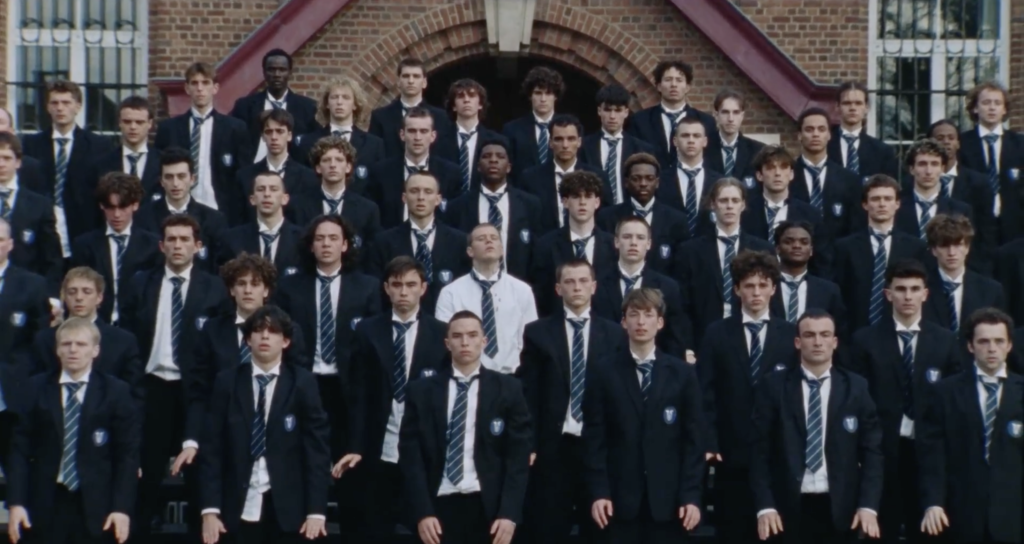
Part I plunges us into an elite British boarding school descending into Lord of the Flies‑style chaos: bullying, broken furniture, and feral screaming. It is uncomfortable, visceral, and seemingly directionless. Then comes Part II. The piano chords swell, the violence halts, and the schoolboys—bruised and breathless—assemble on the grand stone steps. In a single, unbroken take, they break into a tightly choreographed, hypnotic dance.
The choreography was created by Damien Jalet, a Franco‑Belgian dancer known for his work with theatre director Romeo Castellucci and on the film Suspiria (2018). Jalet’s movement vocabulary for STORM draws from voguing, contemporary dance, and even animalistic gestures. The boys roll their shoulders, snap their heads in unison, and slide across the wet steps with a grace that feels both fragile and militant.
What makes this sequence so powerful is its narrative shift: the dance is not an escape from violence but a transformation of it. The coordinated movements become a quiet protest, a reclaiming of space and agency. In interviews, Jalet explained that he wanted the choreography to “portray the feeling of finding your tribe—when the outcasts realise they are stronger together.” This is GENER8ION at its finest: using the human body to articulate what words cannot.
High Fashion Meets Industrial Beats: Dior & Holly Blakey (2017)
GENER8ION’s choreographic reach extends beyond music videos into the world of luxury fashion. In 2017, Dior commissioned the project to soundtrack its campaign for the “Poison Girl” fragrance. The result was a short film set to GENER8ION’s track “No Rebel” featuring Tayla Parx, directed by Romain Gavras and choreographed by Holly Blakey.
Blakey, a British movement director celebrated for her work with Björk, Kylie Minogue, and at the Royal Opera House, crafted an intense, brooding dance‑off between two young women in a dimly lit warehouse. The choreography blends hip‑hop, contemporary, and what Blakey calls “broken gestures”—jerky, incomplete movements that convey internal conflict. As the driving, synth‑heavy beat of “No Rebel” pulses, the dancers circle each other, mirroring and then breaking away, their bodies telling a story of rivalry, desire, and self‑assertion.
This collaboration demonstrated that GENER8ION’s sound is inherently choreographic—its irregular rhythms and ominous basslines practically demand physical interpretation. For Dior, the campaign was a departure from typical perfume ads, replacing romantic clichés with raw, kinetic energy.
Why Choreography? GENER8ION’s Artistic Philosophy
At first glance, a project rooted in electronic music and provocative filmmaking might not seem like an obvious home for dance. Yet GENER8ION’s persistent use of choreography reveals a deeper artistic philosophy:
Movement as Social Commentary – In an age of digital isolation, synchronised human movement is a powerful reminder of our physical, collective existence. Whether it’s 36,000 students or a dozen schoolboys, GENER8ION uses dance to explore themes of conformity, rebellion, and solidarity.
Scale and Intimity in Tension – The project moves between the macro (China) and the micro (the boarding school steps). This contrast keeps audiences off‑balance, forcing them to reconsider what choreography can mean—from totalitarian precision to fragile, improvised unity.
The Failure of Language – Many of GENER8ION’s narratives involve characters who cannot or will not speak. Choreography becomes their voice. In STORM II, the boys never explain why they dance; we simply feel the release, the defiance, the hope.
Theatricality for the Big Screen – As Romain Gavras has emphasised, GENER8ION creates work for “very large screens in physical locations.” Choreography, with its need for space and visual clarity, thrives in such settings. It is an antidote to the shrinking, personalised screen.
The Choreographers Behind GENER8ION
No discussion of GENER8ION’s dance legacy would be complete without acknowledging the brilliant movement directors who brought the vision to life:
Damien Jalet (STORM I & II) – Known for his haunting, ritualistic style that blends contemporary dance with ancient traditions. His work often explores the border between the human and the monstrous.
Holly Blakey (Dior “Poison Girl”) – A master of emotional abstraction, Blakey creates choreography that feels both spontaneous and meticulously structured. She has since become one of the most sought‑after movement directors in fashion and music.
Inigo Westmeier (M.I.A. video) – Though primarily a director, Westmeier’s ability to orchestrate tens of thousands of untrained performers into seamless choreography is a feat of its own kind.
These collaborators understand that GENER8ION’s music—with its heavy synths, distorted vocals, and relentless beats—demands a physical response. They provide it, and in doing so, they elevate the project from a listening experience to a full‑body immersion.
Legacy and Influence
GENER8ION’s commitment to choreography has already left its mark on visual culture. Music videos from artists like FKA twigs, Rosalía, and The Weeknd have increasingly featured ambitious, narrative‑driven dance sequences. Meanwhile, fashion houses from Balenciaga to Gucci have turned to choreographed group movements for their runway shows and campaigns. GENER8ION did not invent dance in music videos, but they restored its power as a storytelling tool—not just for spectacle, but for substance.
Moreover, the project’s insistence on large‑format, physical viewing experiences has inspired a counter‑trend to the algorithms of TikTok and Instagram Reels. There is a growing hunger for art that demands your full attention, that fills your peripheral vision, that moves real bodies in real space. GENER8ION’s choreography is a battle cry for that hunger.
Conclusion
GENER8ION choreography is far more than a series of well‑executed moves. It is a language of resistance, a mirror to our collective anxieties, and a celebration of the strange, beautiful, and often violent ways humans find connection. From the staggering precision of 36,000 martial artists to the bruised tenderness of schoolboys dancing on stone steps, GENER8ION reminds us that rhythm is older than speech, and that sometimes the most profound stories are told not in words, but in the silent, synchronised poetry of the body.
As the project continues to evolve—with hints of new music and visuals on the horizon—one thing remains certain: wherever GENER8ION goes, the dancers will follow. And we will be watching, not on our phones, but on the largest screens we can find, ready to feel every gesture in our bones.